
Industrial Clarifiers for Industrial Wastewater Treatment
Efficient wastewater management for industries
Efficient wastewater management for industries

Industrial clarifiers use gravity settling to separate suspended solids and precipitated contaminants from wastewater. By using inclined settling plates, a properly designed industrial clarifier can provide a large effective settling area within a relatively small footprint.
Met-Chem industrial clarifiers are engineered around the specific wastewater flow rate, solids loading, settling characteristics, chemical treatment process, and discharge requirements of each application.

An industrial clarifier is a wastewater treatment device designed to separate suspended solids from water through gravity settling.
In many industrial wastewater applications, dissolved metals or other contaminants are first converted into suspended solids through chemical treatment. Coagulants and polymers may then be used to create larger, faster-settling floc.
The wastewater then enters the clarifier, where the solids settle and clarified water exits the system.
A typical industrial wastewater treatment process may include:
Equalization → pH Adjustment → Coagulation → Flocculation → Industrial Clarifier → Sludge Dewatering → Final Treatment
The settled sludge collects in the bottom of the clarifier and can be pumped to a Met-Chem filter press for dewatering.
The clarified water can then proceed to additional treatment or discharge depending on the application.

One source of confusion when researching industrial clarification equipment is the number of different names used for similar technologies.
You may see this equipment described as:
These terms often describe the same basic principle: using inclined settling surfaces to increase the effective settling area available for solids separation.
Met-Chem specializes in inclined plate industrial clarification systems for industrial wastewater applications.
Instead of relying only on the surface area of a large open settling tank, an inclined plate clarifier contains multiple closely spaced settling plates installed at an angle.
As chemically treated wastewater flows through the plate area, suspended solids have a relatively short distance to travel before contacting a settling surface.
The solids collect on the plates and slide downward into the sludge collection area.
Clarified water continues upward and exits through the clarifier effluent section.
The result is a large amount of effective settling area within a compact clarifier footprint.
This is why inclined plate and lamella clarification are widely used for industrial wastewater treatment systems where floor space may be limited.
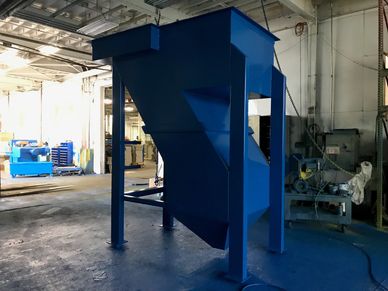
Met-Chem has been supplying industrial wastewater treatment equipment for decades. Our clarifiers are designed as part of the overall wastewater treatment process rather than simply as standalone tanks.
Successful clarification depends on much more than the physical size of the clarifier.
Met-Chem considers:
A clarifier should be sized around the wastewater treatment process—not simply the pipe size or maximum pump flow.
One of the most important considerations in industrial clarifier design is providing sufficient time for chemical treatment, floc formation, and solids separation.
A clarifier that is undersized may look acceptable on paper based solely on flow rate, but insufficient retention time can result in poor settling and suspended solids carrying over into the effluent.
Met-Chem designs its industrial clarification systems with conservative retention time and settling criteria appropriate for industrial wastewater applications.
Providing adequate tank volume can help:
This is particularly important with industrial wastewater because influent chemistry and solids loading can vary throughout the operating day.
The inclined plate pack is at the heart of a lamella or inclined plate clarifier.
Instead of requiring solids to settle the entire depth of a conventional tank, closely spaced plates provide numerous settling surfaces.
Met-Chem plate packs are designed to provide a high effective settling area while maintaining appropriate spacing for industrial wastewater solids.
Plate angle and spacing are important.
The plates must allow solids to settle onto the plate surfaces and then move downward into the sludge collection area rather than accumulating permanently within the pack.
Met-Chem can provide complete clarifiers as well as replacement clarifier plate packs for existing industrial clarification systems.
Settling the solids is only half of the clarification process.
Those solids must also be removed from the clarifier.
Met-Chem industrial clarifiers incorporate a sludge collection section below the settling area. Settled solids move downward into this area where they can be periodically or automatically removed.
Allowing excessive sludge to accumulate can eventually interfere with clarification.
For many industrial applications, Met-Chem recommends frequent automatic sludge blowdown rather than waiting for a large volume of sludge to accumulate.
The discharged sludge can then be transferred to a sludge holding tank or directly into a dewatering process.
One of the most common Met-Chem industrial wastewater treatment combinations is an industrial clarifier followed by a filter press.
The two pieces of equipment perform different jobs.
The industrial clarifier handles a continuous wastewater flow and concentrates the suspended solids into a sludge stream.
The filter press then dewaters that concentrated sludge in batches.
This allows the clarifier to process wastewater continuously while the filter press produces a substantially drier filter cake for disposal.
Clarifier: separates solids from the main wastewater stream.
Filter Press: removes water from the concentrated sludge.
Together, they provide an effective solids separation and sludge dewatering system for many industrial wastewater applications.
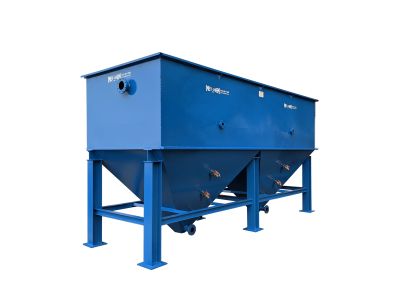
Industrial clarifiers can remove precipitated metals and other suspended solids following pH adjustment, coagulation, and flocculation.
Chemical precipitation converts dissolved metals into solids that can then be separated using an inclined plate clarifier.
Clarification can be used following neutralization and precipitation to separate aluminum hydroxide and other suspended solids from treated wastewater.
Machining, fabrication, parts washing, surface finishing, and other manufacturing processes can generate wastewater containing suspended or chemically precipitated solids.
Industrial clarification can be used where suspended mineral solids must be separated from process water.
Clarifiers can be integrated into chemical wastewater treatment systems when contaminants can be precipitated or coagulated into settle able solids.